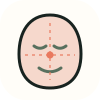
Three sections
Hairline to brow, brow to nose base, and nose base to chin, taken along the vertical face axis.
The classical convention divides the face into three equal vertical sections — the 33/33/33 reference. Upload a photo to measure yours, get each section as a percentage, and see exactly how far each one sits from 33.3%.
Analyze a photo →Upload a front-facing photo — hairline, brow, nose base and chin landmarks are measured locally to build the three sections.
Front-facing, neutral expression, even light. JPG, PNG, WebP, HEIC or HEIF up to 10 MB.
or drag and drop it here
A typical first run loads about 15 MB of model/runtime files, then the browser caches them. Nothing is submitted to our analysis API.
The first run can take a moment. Your photo remains on this device.
Your photo and landmarks stay in page memory and are cleared when you reset or leave. Face-shape tools keep a small result summary in this tab for up to 30 minutes so you can continue to hairstyles or glasses. Clear the result to remove it.
The output is built from inspectable photo geometry and a separate image-quality signal.
Hairline to brow, brow to nose base, and nose base to chin, taken along the vertical face axis.
Each section is shown with its signed difference from the 33.3% convention.
Average deviation is converted into a single 0–100 thirds-balance value.
Four landmarks define the three vertical sections on the eye-line-aligned axis.
Sections are expressed as percentages of total measured height, so image size does not matter.
Each percentage is compared with the even-thirds reference.
The upper third depends on a visible hairline; receding, covered or shaved hairlines make it the least reliable section.
Equal thirds is an artistic drawing convention from Renaissance proportion studies, not a biological norm.
Head tilt toward or away from the camera compresses the sections unevenly.
A classical drawing convention that divides the face into three vertical sections — hairline to brow, brow to the base of the nose, and the base of the nose to the chin — which the convention treats as roughly equal.
No. Most measured faces have unequal thirds. The convention is a compositional guide from art instruction, not a medical or aesthetic requirement.
It is the same convention written as percentages: each of the three vertical sections taking about a third of face height. A face measured at 33/33/33 matches the classical reference exactly, which is uncommon rather than expected.
It is bounded by the hairline, which the landmark model estimates rather than measures directly. Hair covering the forehead, or a high or receding hairline, shifts it the most.

Free facial fifths calculator: upload a photo to split your face width into five segments and see how far each one sits from the one-eye-width reference.
Open tool →
Free face ratio calculator: upload a photo to measure your facial proportions — thirds, fifths-related eye spacing and feature widths — with an annotated image.
Open tool →
Free facial width-to-height ratio calculator: upload a photo to get your fWHR from bizygomatic width and upper-face height, with both measurements shown.
Open tool →