Two product paths with different jobs
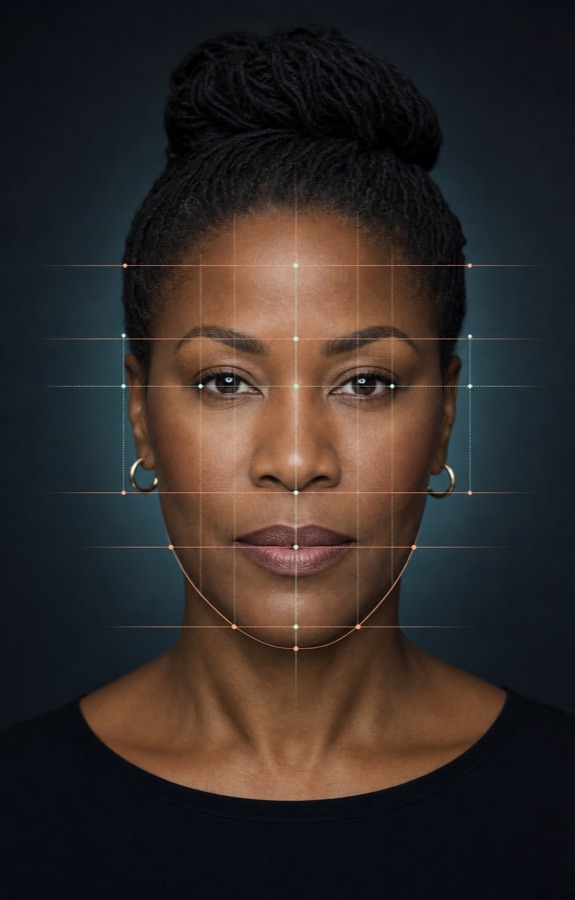
ARF Local Geometry v3.0 powers all 20 free tools, including the overall score. It detects 478 visible face landmarks in the browser and calculates documented two-dimensional distances, angles, ratios and photo-quality signals. The free photo, landmarks and result are not submitted to our server.
ARF Full Report v1.0 is an account product that costs 10 wallet credits. After Google sign-in and explicit consent, it sends one resized adult portrait for transient model processing and saves the resulting text and scores to the user’s account. It does not save the photo.
Neither path determines objective attractiveness or identifies health, personality, ethnicity, gender, age, identity or social value.
The free local geometry engine
The browser loads MediaPipe Tasks Vision 0.10.35 and the site-hosted Face Landmarker model. A suitable face produces 478 normalized landmarks. AI Rate Face converts the visible x/y coordinates into the processed image’s pixel space before running its own formulas.
| Tool family | Primary calculation | Output | Important caveat |
|---|---|---|---|
| Symmetry | Pose-aligned residuals for matched landmark pairs | Regional values and overall index | Expression and yaw can resemble asymmetry. |
| Face shape | Three width ratios plus jaw corner and chin taper angles, softmax-weighted against seven reference profiles | All seven profiles ranked by match percentage | Reference profiles are hand-set design choices, and shape is continuous, not categorical. |
| Proportions | Facial thirds, fifths, eye spacing and selected phi references | Ratios, percentages and reference distance | Classical references are not universal ideals. |
| Jaw and eyes | Contour angles, opening ratios and visible corner tilt | Photo geometry with side-to-side evidence | Not anatomy, health or identity inference. |
| Harmony | Six weighted relationships: symmetry 20%, thirds 18%, feature widths 18%, jaw 17%, midface 15%, eye spacing 12% | Harmony score plus helps / reduces / photo-related lists | Weights are a design choice; definitions differ between tools. |
| Midface and fWHR | Eye-line-to-lip height ÷ interpupillary distance; bizygomatic width ÷ brow-to-lip height | Ratio, range label and both source distances in pixels | Published definitions vary, so values are not cross-tool comparable. |
| Side profile | Gonial, nasofrontal, nasolabial and convexity angles, plus E-line lip offsets | Angles flagged in or out of cited ranges, behind a head-turn gate | 2D soft tissue, not a cephalometric measurement. |
| Photo confidence | Brightness, contrast, edge sharpness, coverage, roll and yaw proxies | Suitability score, ranked drivers and retake notes | Not optical testing or a truth probability. |
Eye-line alignment reduces roll distortion in symmetry comparisons, but two-dimensional coordinates cannot fully correct head rotation, camera perspective, focal length, expression or obstruction.
How the free overall score is composed
The total is calculated locally with a fixed formula:
Overall = visible symmetry × 0.30 + proportion balance × 0.25 + feature balance × 0.25 + photo presentation × 0.20
- Visible symmetry uses pose-aligned left/right landmark residuals.
- Proportion balance combines facial thirds, fifths, eye spacing and selected ratio references.
- Feature balance combines jaw, eye and central-feature relationships.
- Photo presentation reflects local quality and pose suitability.
The weights and reference ranges are product design choices, not scientific laws or universal beauty standards. They change only with a new published version.
Face geometry versus photo presentation
A single combined score cannot tell you whether a low number came from your face or from your photograph. Every free result therefore also reports two separate values:
Face geometry = visible symmetry × 0.34 + proportion balance × 0.33 + feature balance × 0.33
- Face geometry excludes the photo-quality term entirely, so it is the value that should stay roughly constant across photos of the same face.
- Photo presentation is the photo-confidence score, decomposed into six ranked drivers: head angle (24%), sharpness (22%), lighting (20%), tonal contrast (16%), framing (10%) and resolution (8%).
- The gap compares these two separate indices. It is not a point deduction from the combined score. With other components fixed, a ten-point change in photo presentation changes the unrounded total by two points.
Face geometry is not fully pose-independent — symmetry in particular still drifts with head rotation, and expression genuinely changes the measured landmarks. The Face Score Consistency Test measures the spread of both values across two or three of your own photos rather than asking you to trust the claim.
The geometry formulas are deterministic for identical landmarks and image-quality inputs. End-to-end results also depend on image decoding, model inference, browser and runtime version, so this does not promise identical results across every device. Our repeatability experiment isolates the calculation layer.
How the credit-powered Full Report works
- The browser first detects one face and checks pose, light, clarity and framing locally.
- The user must be signed in, hold at least 10 credits, and confirm adulthood, photo rights and cloud processing.
- The resized photo is sent through the same-origin Worker to a privacy-filtered OpenRouter model route.
- The model returns a strict schema containing four scores, shape context, 4–6 visible-feature observations, style directions and a repeatable portrait plan.
- The Worker normalizes and saves the report JSON. It does not save the original or resized photo.
The paid report uses the same 30/25/25/20 total formula after the model returns its four visual estimates. A fixed schema, low temperature and fixed seed reduce unnecessary variation but do not make a generative visual model deterministic.
If the result is no face, multiple faces, uncertain adulthood, low quality or a processor failure, all 10 credits are returned automatically.
What confidence means
Confidence describes whether this photo is suitable for a repeatable visual estimate. It is not the probability that the score or shape label is objectively true.
Confidence falls with strong head turn or tilt, close wide-angle perspective, uneven light, blur, heavy filters, obstruction, tight cropping or uncertain face detection. A low-confidence result should lead to a retake, not a stronger conclusion.
Known limitations
Attractiveness is subjective
Preferences vary across people, cultures and contexts. A photograph cannot capture movement, voice, chemistry, warmth, style or personality.
Photos are not neutral
Distance, focal length, head position, lighting and expression change visible width, symmetry and feature prominence. Different photo conditions are not a reliable before-and-after comparison.
Bias remains possible
We do not claim equal performance across every demographic group. A fairness claim would require a documented evaluation dataset and published results that we do not currently have.
No medical or high-impact use
Do not use the service to diagnose a condition, recommend surgery, screen applicants, rank strangers or make decisions about another person.
Adult-use and content rules
The service is restricted to adults aged 18 or older. Users must own the selected photo or have the pictured adult’s clear permission. The paid model is instructed to reject age-ambiguous photos; its refusal is a safety state, not an age estimate.
Insults, sexualization, discriminatory labels, medical claims and cosmetic-surgery recommendations are outside the product scope. See the Terms of Use.
References and sources
These sources document the landmark model and give context for perspective and ratio limits. They do not validate our score weights, seven shape profiles or selected guide intervals.
- MediaPipe Face Landmarker documentation — Google AI Edge. A landmark detector is not an attractiveness model and does not validate our scoring weights.
- Nasal Distortion in Short-Distance Photographs: The Selfie Effect — Ward et al., JAMA Facial Plastic Surgery (2018). This paper does not test AI Rate Face. Our camera simulation uses its own stated dimensions and is not a reproduction of the study.
- New “golden” ratios for facial beauty — Pallett, Link & Lee, Vision Research (2010). Its measured arrangements are not a general endorsement of 1.618, our four selected ratios, or a universal beauty score.
- The role of the golden proportion in the evaluation of facial esthetics — Rossetti et al., The Angle Orthodontist (2013). Results from one study and one measurement protocol should not be generalized to every face, culture or photo.
For the scope of each reference, read References & Sources. For the effect of changing selected inputs, explore our five reproducible computation experiments. Their data tests formulas, not population-level accuracy.
Version history
| Version | Date | Method | Status |
|---|---|---|---|
| ARF Local Geometry v3.0 | July 2026 | Free on-device overall score, two multi-photo tools and 17 focused tools. | Current |
| ARF Full Report v1.0 | July 2026 | 10-credit, account-based, structured cloud report. | Feature-gated |
| ARF Visual v2.0 | July 2026 | Public server-side basic report. | Retired |