Paired landmarks
Compares horizontal distance from the facial midline and vertical alignment for matched left-right points.
Upload a photo and see how paired landmarks compare across the eyes, brows, nose, mouth and jaw. It is analysed in your browser and never leaves your device. The result corrects for eye-line rotation and reports regional evidence instead of mirroring half a face.
Analyze a photo →Upload a front-facing photo. It is analysed in this browser and never uploaded; the first run loads a local face-landmark model.
Front-facing, neutral expression, even light. JPG, PNG, WebP, HEIC or HEIF up to 10 MB.
or drag and drop it here
A typical first run loads about 15 MB of model/runtime files, then the browser caches them. Nothing is submitted to our analysis API.
The first run can take a moment. Your photo remains on this device.
Your photo and landmarks stay in page memory and are cleared when you reset or leave. Face-shape tools keep a small result summary in this tab for up to 30 minutes so you can continue to hairstyles or glasses. Clear the result to remove it.
The eyes, brows, nose, mouth and jaw have separate paired-landmark comparisons. One shifted mouth corner need not mean the rest of the face differs by the same amount. The overlay helps you check what the detector actually measured.
By AI Rate Face · Updated September 8, 2026 · Sources & reference choices
The output is built from inspectable photo geometry and a separate image-quality signal.
Compares horizontal distance from the facial midline and vertical alignment for matched left-right points.
Separates the eyes, brows, nose, mouth and jaw so one area cannot hide another.
Uses the eye line and nose offset to flag roll or yaw that can distort the estimate.
A browser-based model finds one face and its visible landmark coordinates.
The eye line defines a rotated coordinate system for left-right comparisons.
Normalised regional differences become an explainable 0–100 geometry score.
Expression, lens distortion, lighting and head rotation can change apparent symmetry.
Human faces are naturally asymmetric; a higher score is not a health or beauty diagnosis.
The tool measures a single two-dimensional photo, not bone structure or three-dimensional anatomy.
No. Natural asymmetry is normal and can be visually distinctive. This tool only describes visible paired geometry in one photo.
Camera distance, head angle, expression and lighting move visible landmarks. Use the same neutral, front-facing setup for comparison.
No. You choose a photo, but it is never sent anywhere: the tool loads its model into your browser and performs the measurement on your device.
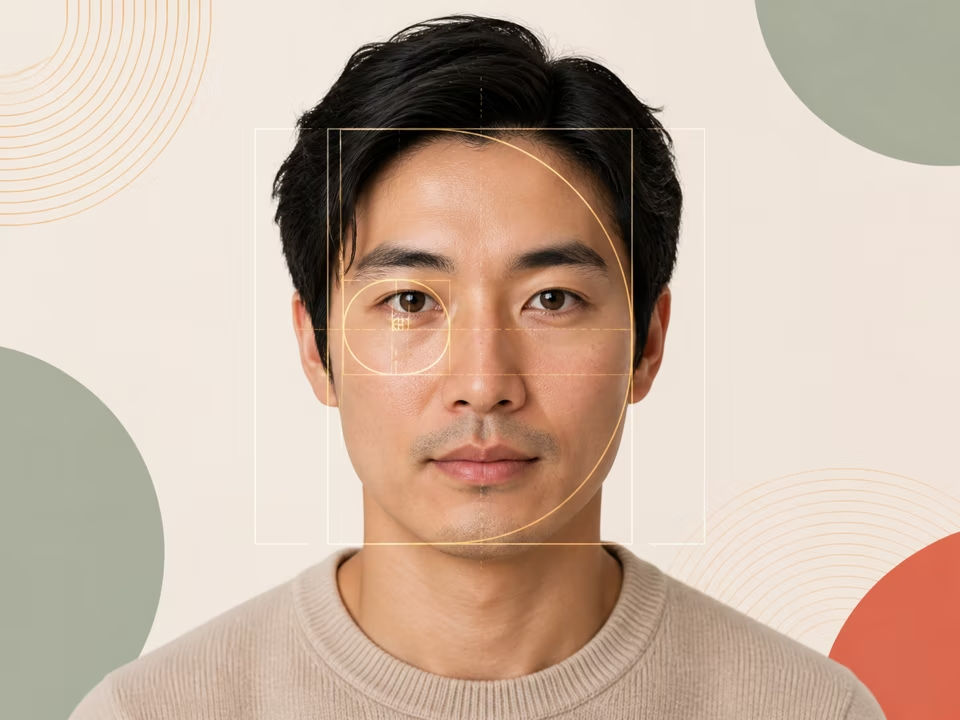
Free golden ratio face calculator: upload a photo to get your golden ratio face score, with every measured ratio, its phi reference and the difference shown.
Open tool →
Free facial harmony test: upload a photo for a 0–100 harmony score from six weighted relationships, plus what helps it, what lowers it and what is only the photo.
Open tool →
Run two or three photos of the same face to see how much of a score change is the face and how much is the photography.
Open tool →