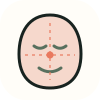
Hairstyles
- •Chin-length texture can add visual width lower on the face.
- •Side-swept or curtain fringe can soften the forehead line.
- •Keep crown volume controlled and add movement below the cheekbones.
A heart contour is widest at the forehead and temples, narrows through the cheeks, and tapers to a pointed chin. The strong difference between a broad upper face and a narrow lower one is the defining pattern, and the pointed chin is what separates it from the profiles that also have wide foreheads.
Check your own shape free →These visual cues can be checked in a mirror. If several do not fit, compare the neighbouring profiles below.
The forehead is the widest part of the face, wider than the jaw by a clear margin.
The chin comes to a visible point rather than a flat or rounded edge.
The jaw is narrow and the taper from cheek to chin is noticeable.
A widow's peak at the hairline is common but not required.
These are the exact reference values the heart profile uses. Your photo is scored against all seven profiles on these five measurements, and the closest ones are returned as percentages rather than a single label.
| Measurement | Heart reference | What it means |
|---|---|---|
| Face length / cheek width | 1.42 | Visible upper-face landmark to chin, divided by cheek-level landmark width; the model does not detect the exact hairline. |
| Forehead / cheek width | 0.98 | Temple-level width as a share of cheek width. |
| Jaw / cheek width | 0.70 | Jaw-corner width as a share of cheek width. |
| Jaw corner angle | 152° | Higher is a softer, more curved corner; lower is a squarer one. |
| Chin taper angle | 94° | Higher is a broader chin; lower is a more pointed one. |
These reference values are hand-set design choices, not population averages fitted to a labelled dataset. They define what this tool means by heart; another calculator using different landmarks will place the boundaries elsewhere.
These are visual-balance conventions, not rules. They describe where volume, width or a line is usually placed to work with or against the natural contour — and either direction is a valid choice.
No. The widow's peak is a common association but not a measurement. What defines the profile is a forehead clearly wider than the jaw combined with a pointed chin — both of which this detector measures.
Where the face is widest. Heart is widest at the forehead; diamond is widest at the cheekbones with a narrow forehead. Both taper to a point at the chin, so the forehead measurement is what separates them.

Moderately long, with the forehead a little wider than the jaw and a softly rounded chin.
Read guide →
Similar in length and width, with a soft jaw that curves instead of turning a corner.
Read guide →
Short and wide like a round face, but with a jaw that turns a clear corner below the ear.
Read guide →
The longest of the seven profiles, with widths that stay fairly even from forehead to jaw.
Read guide →
Widest at the cheekbones, with both a narrow forehead and a narrow, pointed chin.
Read guide →
A jaw wider than the forehead — the inverse of the heart profile.
Read guide →